
The Dopamine agonist paradox: why mental health charities need to engage
Freddie Waite · 10 October 2026 · 15 minute read · World Mental Health Day
What increasingly strikes us at DAAG is that the dopamine agonist story is not simply a medication safety issue. It is a powerful illustration of a societal and systemic failure to understand – and take account of – mental health, behaviour and judgement.
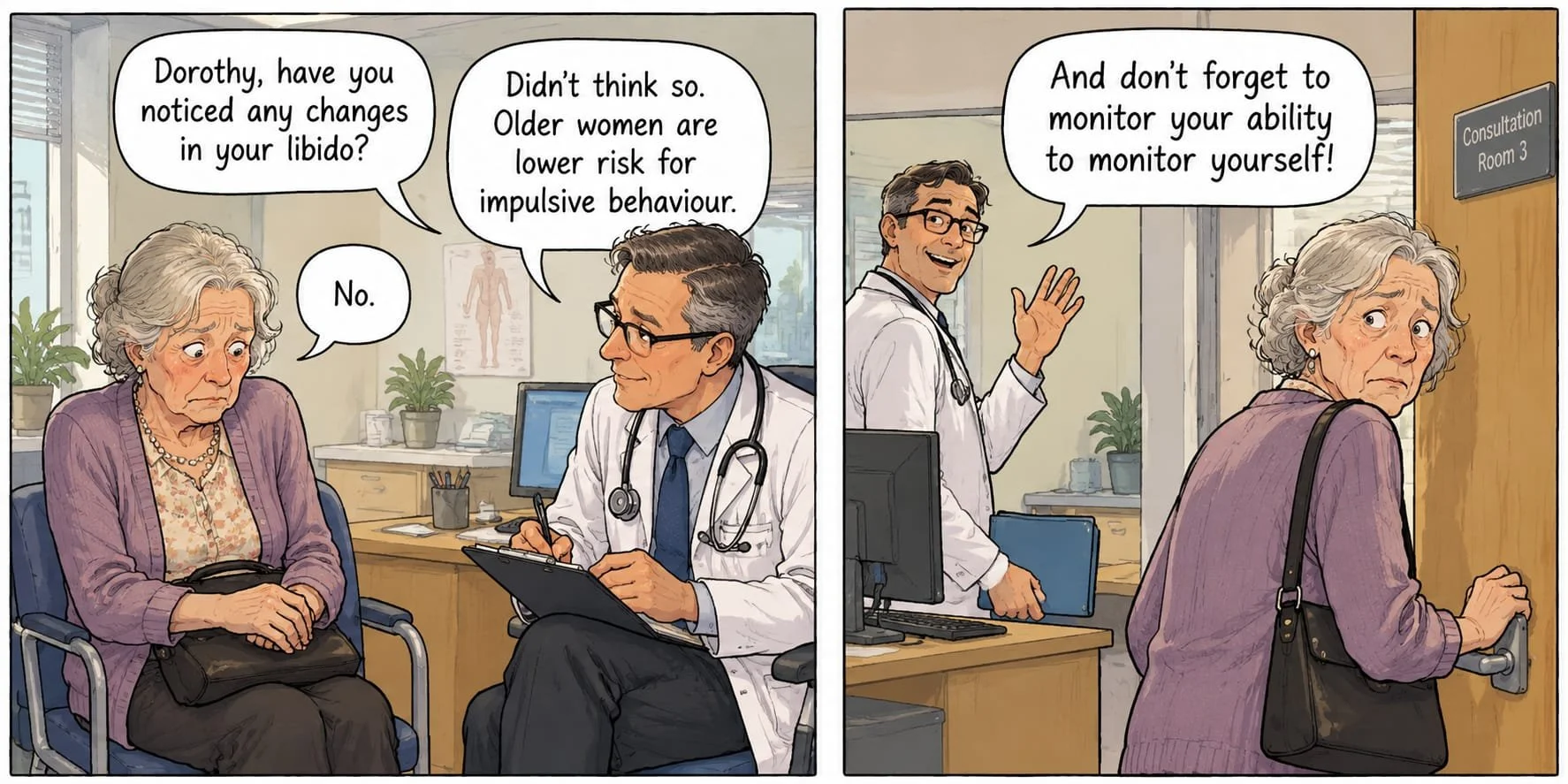
Dopamine agonists are mainly used to treat Parkinson’s disease, Restless Legs Syndrome (RLS) and certain endocrine conditions. But they can cause profound changes in behaviour, with one longitudinal study estimating that over half of Parkinson’s patients taking dopamine agonists will develop an impulse control disorder (ICD) over a five-year period.
For patients on these drugs, ICDs have led to compulsive pornography use and sexual behaviour, binge-eating, uncontrollable spending, and pathological gambling – often with disastrous consequences, such as relationship breakdown, financial ruin, homelessness, criminality, sexual violence (as offender and victim), and suicide. The concern is not the behaviour itself: gambling, spending, pornography or increased sexual activity are not inherently evidence of illness. But it is the loss of control and significant change from someone's previous behaviour and judgement that can make these behaviours problematic and harmful.
The story raises fundamental questions about agency and personal responsibility, and how society and institutions respond when illness or medication changes the way people act.
At the heart of this is an ‘agency paradox’. Dopamine agonists challenge a longstanding convention in medicine: provide patients with long lists of side effects, expect them to recognise when something goes wrong, and take action if problems emerge. But this falls apart when the side effects themselves alter behaviour, insight and judgement.
Yet none of the major mental health charities we contacted currently provide dedicated information on dopamine agonists and their psychiatric and behavioural side effects. We believe this needs to change. In this article, we set out why we believe mental health organisations urgently need to engage with this issue.
Shame and stigma are powerful silencers
A fundamental problem with impulsive behaviour is that cases often go undetected due to the extraordinary silencing power of shame.
Behaviours associated with impulse control disorders carry an enormous amount of social stigma, particularly when it comes to hypersexuality, gambling and other financially risky behaviours. Patients often feel a deep sense of regret, shame and embarrassment for their actions.
In addition, a fear of judgement and disappointment means they often hide their struggles from loved ones, friends, and healthcare professionals. This can increase isolation and reinforce the cycle of impulsive or compulsive behaviour.
And that’s if patients even realise what is happening to them. Dopamine agonists can also impair insight, so many patients won’t actually recognise or understand the harms they are causing. The drugs can also cause dependency and significant withdrawal symptoms, making them extremely difficult to stop.
Recognition is made even harder because these problems do not necessarily emerge immediately after starting treatment. Impulse control disorders can develop months or even years later, by which point neither patients nor healthcare professionals may make the connection with a medication that has been taken for a long time. Changes in behaviour may instead be attributed to the individual themselves, their circumstances or their underlying condition.
But physical health trials fail to look hard enough
As a result, studies into dopamine agonist side effects often fail to detect impulsive behaviour.
Researchers and whistle-blowers have told the drug companies for decades the likelihood and severity of these side effects are underestimated, and in the US have called for ‘black box’ warnings on the medication packaging like you’d see on a packet of cigarettes - but no such warning has ever been introduced.
One cause of this underestimation is how researchers look for these behaviours in the first place. Many of the earliest clinical trials relied on patients self-reporting side effects, which, perhaps not surprisingly, produced relatively low estimates.
But absence of evidence does not equate to evidence of absence. When looking for impulsive behaviour, results are highly sensitive to how the data is collected.
Later independent studies improved data collection methods, such as by incorporating smarter questionnaires informed by psychologists and involving family members. Arguably not perfect, but better, and these studies revealed much higher results. Simply put, you have to dig beneath the surface, and the more you do that, the higher the results.
But rather than discard the earlier (ineffective) studies, their results continue to muddy the picture. Comparing studies with vastly different methods of data collection – measuring different behaviours, in different ways, over different periods of time – will produce a wide range of results (3-43%, according to this study, cited by Parkinson’s UK).
A lazy interpretation would be that the link between dopamine agonists and ICDs is inconclusive, which may help explain why ropinirole still lists impulsive behaviour as ‘frequency unknown’ - often interpreted to mean negligible, particularly when appearing after ‘very common’, ‘common’ and ‘uncommon’ side effects in the leaflet. Yet even a frequency above just 10% would qualify as ‘very common’.
Augmentation: when worsening symptoms aren't believed
Impulse control disorders are not the only serious complication of dopamine agonist treatment. For people with RLS, long-term dopamine agonist use can cause augmentation – a paradoxical worsening of the condition, where RLS symptoms become more severe, begin earlier in the day and spread to other parts of the body. The updated 2026 RLS Foundation treatment algorithm estimates that 42-70% of patients will develop augmentation within 8-10 years.
Yes, a ‘side effect’ of the medication that makes the very condition it is supposed to treat worse. A bit like paracetamol giving you a headache - but with far, far higher stakes.
And augmentation raises another important issue around mental health: what happens when patients describing severe and distressing physical symptoms are not believed? RLS is more common in women, and we hear from patients who feel their symptoms have been dismissed, minimised or attributed to anxiety, menopause or psychological causes. Some have described being reluctant to fully disclose the severity of their distress or seek help because they fear being regarded as mentally unwell or even being sectioned.
There is a damaging paradox here too. Mental health stigma can lead psychiatric side effects such as ICDs to be hidden through shame; but it can also make patients fear that their physical symptoms will be misinterpreted as psychiatric. In both cases, stigma becomes a barrier to recognition and appropriate care.
Patient leaflets steer behaviour
As a result of the under-recognition, warnings and guidelines have remained inaccurate and ineffective, further prolonging the harms caused. Estimates of how common ICD occurs are either understated or not included at all, and vague descriptions of impulsive behaviour that have gradually emerged are buried in leaflets amongst over 50 other side effects – from hiccups to hallucinations, and everything in between.
Information overload is a well-evidenced principle of behavioural science, where excessive data overwhelms, confuses, impairs decision-making and increases reliance on authorities. Humans cannot generally factor in over 50 variables into a decision to proceed with medication, or what to prioritise in their monitoring. So patients typically look to their physicians to help decipher it all. This isn’t laziness or complacency, it’s human nature.
But in many cases, patients aren't told about these side effects by their doctors at all, leaving them reliant on lengthy patient information leaflets to understand, prioritise and monitor the risks themselves.
Risk factors can give false assurance
Another way in which guidance can steer behaviour is with the reported ‘risk factors’. These are characteristics deemed to make people at higher risk. For example - young, male, history of smoking or other addictions, or depression and anxiety.
However, the evidence behind these risk factors is far from conclusive. ICD research depends heavily on people recognising and disclosing highly stigmatised behaviour. Yet shame, stigma and insight vary significantly across patient groups. It simply cannot be assumed that the likelihood of reporting impulsive behaviour corresponds to the likelihood of experiencing it.
Thought experiment: does anyone think women in their 80s are equally likely to report they have been watching pornography all day as men in their 30s?
Similarly, perhaps people with a history of depression, anxiety or addiction, are simply the people who are most accustomed to recognising and discussing difficult questions about their mental health and behaviour?
But even if the reported associations are true, when studies show that over half of dopamine agonist users for Parkinson’s disease may develop an ICD over five years, we are not necessarily distinguishing between people who are ‘at risk’ and people who are ‘not at risk’. Rather we may just be talking about high-risk and even-higher-risk groups.
What the risk factors can do, however, is give patients who fall outside of these characteristics (the vast majority of patients) false assurance that this is something that just happens to other people. We are naturally wired to favour information that makes us feel safe, and it is incredibly hard to imagine the idea of losing the control we have always had. This is straightforward optimism bias and normalcy bias - more well-established concepts in behavioural science.
Some of these factors - such as the inclusion of people with a history of addiction or depression - may even trigger biases or reinforce the idea that ICD is principally a problem for ‘those sorts of people’. But the reality is these side effects can happen to anyone.
This can affect healthcare professionals too. Some patients have been told by practitioners they do not need to worry because they do not fit the recognised risk factors – whether through misinterpretation of the information themselves or simply an understandable and natural desire to reassure.
The net result of all this is that existing guidance may actually be telling people who are the least likely to notice or disclose impulsive behaviour (such as elderly women), that they are the ones who least need to worry. This isn't to say they are equally at risk. It is to say the evidence does not allow us to assume they aren't - and that assumption is dangerous.
And there is a disturbing irony here. The dopamine agonist story repeatedly demonstrates a striking failure to account for human behaviour when detecting psychiatric harms. Yet when it comes to framing risk information, that understanding of human behaviour appears considerably more sophisticated.
The convention in medication - ‘try it and stop if there are problems’ - doesn’t work for psychiatric side effects
In healthcare, there is a seemingly reasonable convention when deciding whether to start a medication: try it, see how you get on, and stop if the side effects outweigh the benefits.
This is a natural conclusion to reach, particularly with the sheer volume of side effects listed. After all, if the possibility of side effects were enough to rule out a medication, who would ever take anything?
This convention relies on four key assumptions:
that patients understand what the potential side effects actually mean;
that they will recognise a side effect if it happens to them;
that they will retain the judgement and insight needed to decide when the harms outweigh the benefits;
and that they will then be able to stop the medication.
However, with dopamine agonists, none of those assumptions can safely be taken for granted.
Firstly, even if patients are explicitly told about these particular side effects, many people will find the idea of losing impulse control incredibly difficult to imagine. As humans we take for granted our ability to assess, filter and reject impulses. We are anchored to our lived experience of control and agency, and interpret the warnings through the lens of our current minds.
Often people may think, “well I would notice”, “I wouldn’t let it get that far”. But they don’t realise, in coming to those conclusions, they are assessing the risk using precisely the abilities that may later become impaired.
And once those changes begin, recognising them is not straightforward. Dopamine agonists can impair insight, meaning patients may not realise their behaviour or judgement has changed. Even where they do recognise a change, they may not experience it as a problem in the same way that their family or their pre-medication self would have done. We hear accounts from people who describe no longer understanding that their behaviour was harmful, even no longer caring. They may even prefer aspects of the ‘new them’ – feeling more confident, energetic, sexual or spontaneous – even where associated behaviours are causing harm to themselves or others.
This is the agency paradox: how do you judge whether your judgement has changed? How do you recognise impaired insight when it is your own insight that may be impaired?
Then, even when someone does recognise the problem and wants to stop, that may not be easy either. Dopamine agonists can be extremely difficult to wean off, with some patients experiencing dependence and significant withdrawal symptoms.
In cases following an ICD, there is also a cruel irony: successfully withdrawing requires almost precisely the opposite abilities to those the ICD has impaired. An ICD can impair restraint, judgement and the ability to resist immediate urges despite potentially devastating longer-term consequences. Withdrawal, meanwhile, requires patience, planning, perseverance, tolerance of short-term discomfort and the ability to prioritise longer-term wellbeing over immediate reward.
We see this struggle repeatedly. On the HealthUnlocked forum, we regularly hear from people determined to stop their dopamine agonist medication. But sadly many go silent for months or even years, only to return with the same problems, still struggling to end the medication.
The apparently simple convention of ‘try it and stop if there are problems’ therefore relies on patients understanding what the warning really means, recognising the change when it happens to them, accurately judging that change using abilities that may themselves have been altered, and finally being able to stop a medication they may have become dependent upon. With psychiatric side effects that can affect insight, judgement and behaviour, every stage of that process can break down.
Failures in the legal and justice system
The difficulties in understanding impaired impulse control do not only affect patients themselves. People experiencing ICDs frequently encounter scepticism from others, with their behaviour interpreted as a lack of willpower or personal responsibility – excuses rather than symptoms. This lack of understanding also extends into the legal and criminal justice system.
Courts can face the same difficulty in understanding impulse control disorders. As a society we find it easier to accept that illness can impair memory, movement or speech than to accept that it can profoundly alter judgement and behaviour, in particular when leaving someone otherwise articulate and outwardly rational.
In England and Wales, diminished responsibility – which explicitly recognises substantial impairment of a person's ability to exercise self-control – is a partial defence only for murder, but not to other criminal offences. More generally, legal concepts of capacity can struggle with the grey area experienced by many people with an ICD: someone may retain the ability to understand information and appear outwardly rational while their ability to weigh consequences, resist impulses or control their behaviour has been profoundly altered.
Dopamine-agonist-related offending raises similarly difficult questions around partial rather than total impairment of agency and responsibility. We are aware of people with no previous history of criminal behaviour who have committed offences while experiencing dopamine-agonist-induced ICDs. Yet the role of their medication can be poorly understood or given insufficient weight, rather than recognised as potentially fundamental to explaining their behaviour.
This is one reason DAAG is seeking to understand just how many people in the prison system are currently taking or have previously taken dopamine agonists, and a review into how their use should be recorded and considered in criminal proceedings.
Gaps in counselling and psychotherapy
After experiencing impulsive behaviour, people are often left trying to come to terms with actions completely at odds with their previous sense of self, alongside the damage those actions may have caused to partners, friends and families.
It can be extremely difficult to reframe behaviours, even with a clear link to medication, as things that happened to them, rather than by them. Questions about identity, responsibility, guilt and shame can become a significant part of recovery: Was that really me? What does what I did say about who I am?
Families can face the same complicated process, trying to make sense of behaviour that may have caused significant harm and distress while recognising the role of the medication. Yet medication-induced changes in behaviour appear to fall into a significant gap in mental health provision. We increasingly hear from people looking for counselling or psychological support specifically to help them make sense of these experiences, but have no specialist services to refer them to.
This is why improving support for recovery and withdrawal is one of DAAG’s campaign objectives. Patients and families should have access to appropriate psychological and practical support to help them process what happened and rebuild their lives.
What does this all say for mental health parity?
The dopamine agonist story also raises an important question about mental health parity. Is successfully treating a physical health condition whilst causing serious psychiatric harm considered a better outcome?
We often appear more willing to accept severe psychiatric and behavioural harms as a price worth paying for treating a physical health condition than we would be to accept comparable physical harms in order to treat a mental health condition.
Advocating for parity has been a core aim for many mental health charities. We’d argue this story demonstrates there is still a long way to go. If mental and physical health are genuinely to be treated with parity, then severe psychiatric harms cannot be regarded as an acceptable collateral cost simply because the condition being treated is physical.
Dopamine agonists are now prescribed for depression
The engagement of mental health charities around dopamine agonists is becoming even more urgent as dopamine agonists move into new patient populations. Pramipexole is increasingly being trialled and prescribed off-label for treatment-resistant depression, bipolar depression and other psychiatric conditions.
If these drugs are to be used in new conditions and patient groups, it is vital the mistakes of the past are not repeated. The history of dopamine agonists must serve as a warning and not a template.
There may also be added complexity in recognising medication-induced changes in behaviour or judgement when they are difficult to distinguish from the underlying condition itself. Dopamine agonists are being used to alter mood, motivation and behaviour, while some of their most serious adverse effects also involve changes in mood, motivation and behaviour.
This creates two potential problems of attribution. First, changes caused by the medication may be attributed to the underlying condition. Increased energy, confidence, sexual drive, spending, risk-taking or goal-directed activity could be interpreted as recovery from depression or emerging bipolar symptoms, rather than recognised as an adverse effect of the medication.
Second, changes may be attributed to the individual themselves. A sudden deterioration in judgement or dramatic change in behaviour may stand out as unusual in someone being treated for Parkinson’s disease or RLS. In someone already experiencing a mental health condition, stigma may make it easier for the same behaviour to be interpreted as simply part of who they are – impulsive, irresponsible or unstable – rather than prompting the question of whether their medication has changed their behaviour.
It should also be noted that several studies in Parkinson’s disease and RLS have previously identified history of depression as a risk factor for developing an ICD. Now the same drugs are being used for depression itself. As discussed earlier, the evidence base around individual risk factors is imperfect. Nevertheless, this raises obvious questions and, at the very least, warrants careful investigation as these drugs move into psychiatric populations.
If dopamine agonists are prescribed for depression, patients should be properly informed of the risks and specifically monitored for changes in behaviour, judgement and impulse control, with family members or carers involved where appropriate. This is an area where mental health charities have an important role to play.
We wrote to six leading UK mental health charities
Taken together, these issues extend far beyond the safety of a single class of medication. They expose wider systemic and institutional failures in how we understand and respond to changes in mental health, behaviour and judgement – including stigma and shame, how psychiatric harms are detected and communicated, how we understand impulse control and personal responsibility, gaps in psychological support, and the unequal treatment of mental and physical health.
The dopamine agonist story presents an opportunity to improve wider understanding of impulse control disorders and how illness and medication can affect judgement and behaviour. And as these drugs increasingly move into the treatment of depression and other psychiatric conditions, the need for the mental health sector to understand these risks becomes more immediate.
It was for these reasons that, in June 2026, DAAG wrote to Mind, Rethink Mental Illness, the Mental Health Foundation, Mental Health UK, Centre for Mental Health and Together UK. We invited the organisations to discuss our work and explore areas of common ground.
Read our letter to the mental health charities in full here.
Their responses
Rethink Mental Illness responded and told us that the use of dopamine agonists in relation to mental health and behavioural side effects was “not something currently on our radar”, while describing it as “clearly an important and under-recognised issue.” Rethink explained that it did not currently have capacity to take on further work in this area, but said it would keep DAAG in mind as its clinical research and policy work develops.
Mind also responded. Its Information Team confirmed that it does not currently have information covering dopamine agonists or impulse control disorders. It has saved our correspondence and said it would consider the issue when deciding which new information topics to develop and when its existing medication information is next reviewed.
We did not receive responses from the Mental Health Foundation, Mental Health UK, Centre for Mental Health or Together UK.
Dopamine agonists can no longer be regarded as an issue confined to neurology. They raise fundamental questions about stigma, agency, psychological support and mental health parity – and they are now moving directly into mental healthcare. Mental health organisations have an important role to play in ensuring that people already affected are better understood and supported, and that decades of mistakes are not repeated in a new generation of patients.
We hope all six organisations will soon engage with us in that work.